



P2Y6 Receptor
The P2Y6 receptor is a G protein-coupled purinergic receptor activated specifically by extracellular uridine diphosphate (UDP), mediating diverse physiological functions in multiple tissues including heart, blood vessels, and brain[1][2]. Mechanistically, P2Y6 signals through Gαq/Ca2+/PKCα and Gα13/ROCK pathways to regulate actin cytoskeleton dynamics, promoting filopodia formation and directed cell migration in both normal and cancerous cells[3]. In the immune system, P2Y6 selectively drives monocyte and macrophage production of pro-inflammatory mediators such as IL-8, MCP-1, and IP-10, while distinguishing from LPS-induced cytokine profiles[2]. Compared with related P2Y isoforms, P2Y6 demonstrates unique ligand specificity for UDP and exhibits widespread tissue expression that contrasts with the more restricted distribution of P2Y1 and P2Y2 receptors[1]. In cardiovascular and inflammatory disease models, P2Y6 contributes to atherogenesis by enhancing macrophage foam cell formation through phospholipase Cβ/store-operated calcium entry/calreticulin/scavenger receptor A signaling[4][5]. Pharmacologically, selective P2Y6 antagonists such as thiamine pyrophosphate have been shown to inhibit receptor-mediated pathological processes, demonstrating potential for experimental intervention in atherosclerosis and inflammatory disorders[4]. These insights collectively underscore the receptor’s utility as a target for studying nucleotide-mediated signaling and therapeutic modulation in both immunological and vascular contexts[6][5].
Références:
- [1]. von Kügelgen I, et al. Molecular pharmacology of P2Y-receptors. Naunyn Schmiedebergs Arch Pharmacol. 2000 Nov;362(4-5):310-23. [Content Brief]
- [2]. Girard M, et al. The P2Y6 receptor signals through Gαq /Ca2+ /PKCα and Gα13 /ROCK pathways to drive the formation of membrane protrusions and dictate cell migration. J Cell Physiol. 2020 Dec;235(12):9676-9690. [Content Brief]
- [3]. Li Y, et al. Macrophage P2Y6 receptor deletion attenuates atherosclerosis by limiting foam cell formation through phospholipase Cβ/store-operated calcium entry/calreticulin/scavenger receptor A pathways. Eur Heart J. 2024 Jan 27;45(4):268-283. [Content Brief]
- [4]. Nishiyama K. The role of P2Y6 receptor in the pathogenesis of cardiovascular and inflammatory diseases. J Pharmacol Sci. 2024 Feb;154(2):108-112. doi: 10.1016/j.jphs.2024.01.003. Epub 2024 Jan 5. PMID: 38246724. et al. The role of P2Y6 receptor in the pathogenesis of cardiovascular and inflammatory diseases. J Pharmacol Sci. 2024 Feb;154(2):108-112. [Content Brief]
- [5]. Li L, et al. P2Y6 receptor: A promising therapeutic target for atherosclerosis. Eur J Pharmacol. 2025 Jul 5;998:177513. [Content Brief]
- [6]. Cox MA, et al. The pyrimidinergic P2Y6 receptor mediates a novel release of proinflammatory cytokines and chemokines in monocytic cells stimulated with UDP. Biochem Biophys Res Commun. 2005 May 6;330(2):467-73. [Content Brief]
-
P2Y6 Receptor Produits associés (16)
Produits associés (16)

- 1
-
MRS 2578
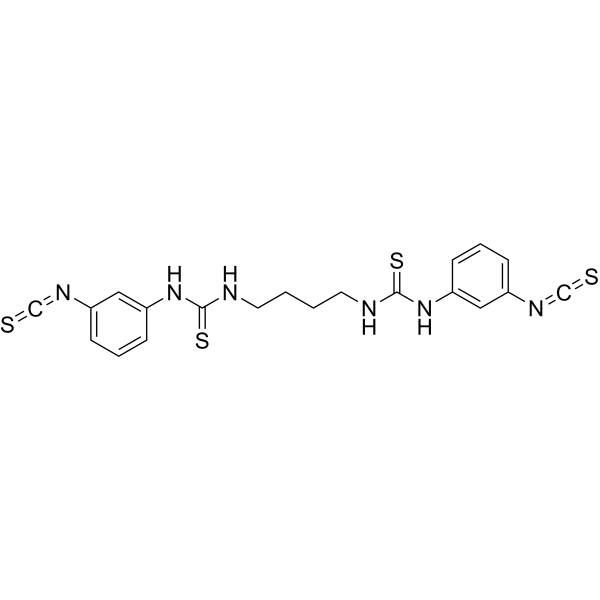 0 ImagesMRS 2578 is a selective and potent P2Y6 receptor antagonist with IC50s of 37 nM (human) and 98 nM (rat). MRS 2578 exhibits insignificant activity at P2Y1, P2Y2, P2Y4, and P2Y11 receptors.
-
Uridine-5'-diphosphate disodium salt
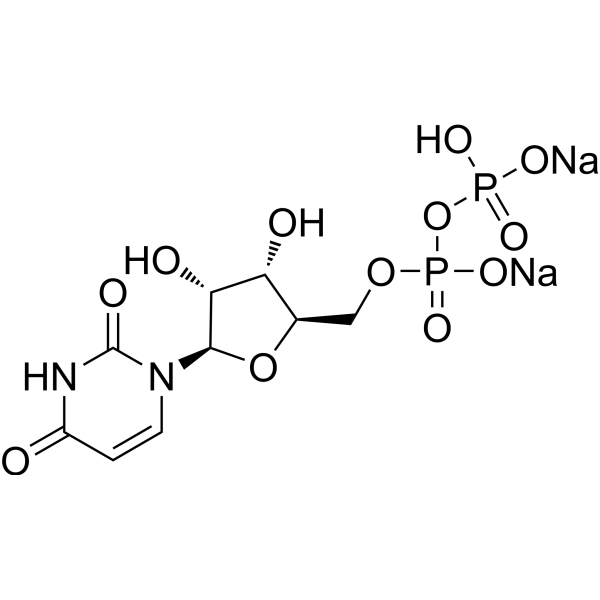 0 ImagesSynonyms: UDP disodium saltUridine-5'-diphosphate (UDP) disodium salt is an important nucleotide made of uracil, ribose, and a pyrophosphate group. Uridine-5'-diphosphate disodium salt is a potent, selective human P2Y6 receptor native agonist (EC50 = 300 nM; pEC50 = 6.52). Uridine-5'-diphosphate disodium salt, an endogenous metabolite, catalyzes the glucuronidation of a wide array of substrates and is used in nucleic acid (RNA) biosynthesis.
-
P2Y6R antagonist 1
 0 ImagesP2Y6R antagonist 1 (compound 5ab) is a selective, orally active P2Y6R antagonist with an IC50 value of 19.6 nM. P2Y6R antagonist 1 has anti-inflammatory activity.
-
P2Y14R antagonist 1
 0 ImagesP2Y14R antagonist 1 (compound I-17) is a selective P2Y14R antagonist with an IC50 of 0.6 nM. It exhibits potent P2Y14R antagonistic activity, both in vitro and in vivo efficacy, and favorable pharmacokinetic profiles. P2Y14R antagonist 1 reduces the release of inflammatory factors and cell pyroptosis through the NOD-like receptor family pyrin domain-containing 3 (NLRP3)/gasdermin D (GSDMD) signaling pathway. P2Y14R antagonist 1 holds promise for research in the field of acute gouty arthritis.
-
Uridine 5′-diphosphoglucose-13C disodium
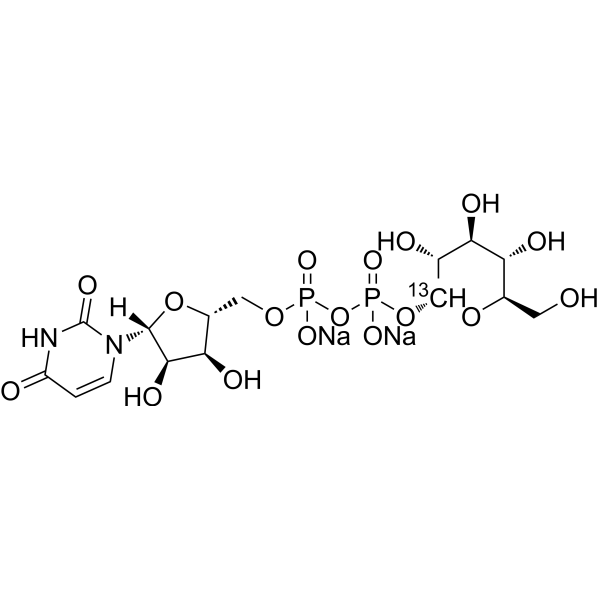 0 ImagesSynonyms: UDP-D-Glucose-13C disodiumUridine 5′-diphosphoglucose-13C (UDP-D-Glucose-13C) disodium is the 13C labeled Uridine 5′-diphosphoglucose disodium (HY-N7032). Uridine 5’-diphosphoglucose (UDP-glucose) disodium, secreted by cardiomyocytes during ischemia and reperfu, is a potent agonist of the proinflammatory P2Y14 receptor. It acts an important role in the regulation of inflammation and neutrophil polarization in neutrophils. Uridine 5’-diphosphoglucose disodium is also the precursor of glucose-containing oligosaccharides, polysaccharides, glycoproteins, and glycolipids in animal tissues and in some microorganisms. Uridine 5’-diphosphoglucose disodium is promising for research in counteracting myocardial infarction/reperfusion (MIR)-induced inflammation in the heart tissue.
-
MRS2693
 0 ImagesCat. No.: HY-117356CAS No.: 93906-48-0MRS2693 is a selective P2Y6 receptor agonist. MRS2693 exerts biological effects by activating the Gq-coupled P2Y6 receptor, the ERK1/2 pathway, and the P2RY6-PLCB3-CAMKK2-PRKAA1-ULK1 signaling cascade. MRS2693 attenuates TNFα-induced NF-κB activation, stabilizes XIAP via AKT-mediated phosphorylation, induces autophagy, and reactivates PRKAA1. MRS2693 can be used in research on diseases including skeletal muscle ischemia/reperfusion injury, TNFα-induced skeletal muscle apoptosis, chronic myelomonocytic leukemia, colorectal cancer, and dry eye disease.
-
MRS4917
 0 ImagesCat. No.: HY-178006MRS4917 is an orally active, potent selective P2Y14 receptor (hP2Y14R) antagonist (IC50 = 2.88 nM, Ki = 1.67 nM) that shows >18,000 fold selectivity against P2Y6R (IC50 = 54 μM). MRS4917 demonstrates oral efficacy in reversing established mechanoallodynia in the chronic constriction injury (CCI) mouse model, while having no effect on thermoregulation. MRS4917 can be used for neurological diseases research.
-
UTPU trisodium
 0 ImagesCat. No.: HY-177726CAS No.: 401618-61-9UTPU trisodium (Compound 19) is a selective P2Y6R agonist with an EC50 of 0.4 μM. UTPU trisodium can activate the intracellular calcium signaling pathway mediated by P2Y6. UTPU trisodium can be used for the research of inflammation.
-
Uridine 5'-diphosphate
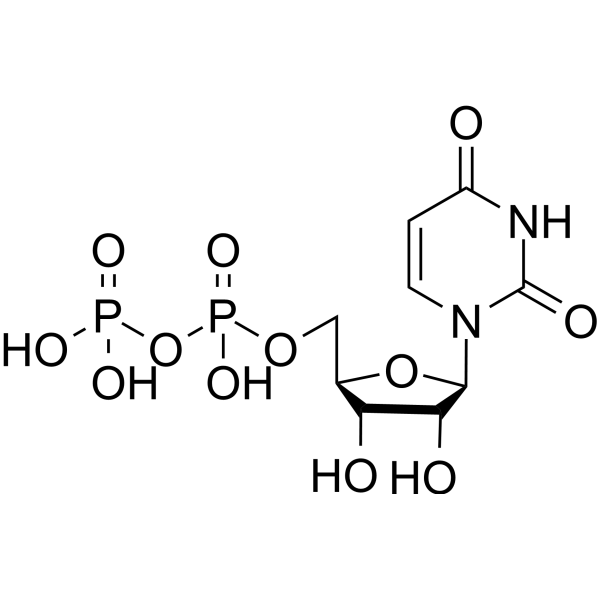 0 ImagesUridine-5'-diphosphate (UDP) is an important nucleotide made of uracil, ribose, and a pyrophosphate group. Uridine-5'-diphosphate is a potent, selective human P2Y6 receptor native agonist (EC50 = 300 nM; pEC50 = 6.52). Uridine-5'-diphosphate disodium salt, an endogenous metabolite, catalyzes the glucuronidation of a wide array of substrates and is used in nucleic acid (RNA) biosynthesis.
-
P2Y1/P2Y6 antagonist 1
 0 ImagesCat. No.: HY-176143P2Y1/P2Y6 antagonist 1 (Compound 3h) is an indolesulfonylhydrazide derivative. P2Y1/P2Y6 antagonist 1 is an orally active tP2Y1 and rP2Y6 antagonist (IC50 of 9.72 and 1.89 μM, respectively). P2Y1/P2Y6 antagonist 1 can be used in the study of neurological diseases, inflammation, cardiovascular diseases and cancer.
-
PSB 0474
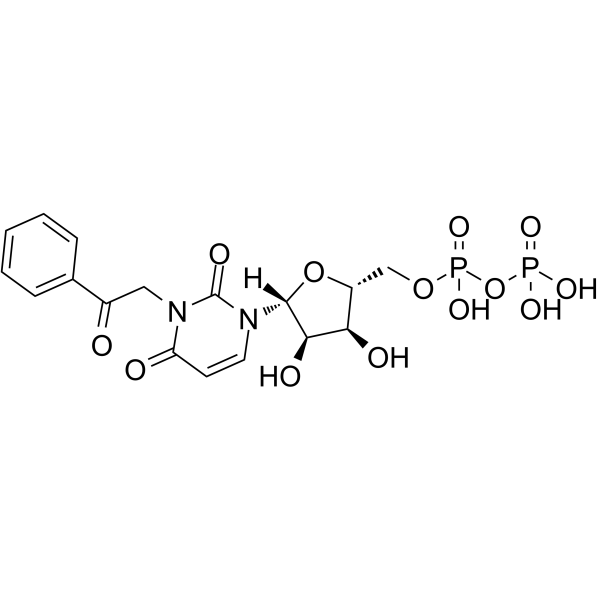 0 ImagesCat. No.: HY-108654CAS No.: 917567-60-3PSB 0474 (3-phenacyl-UDP) is a UDP (HY-113359) analog and selective P2Y6 receptor agonist, with an EC50 value of 70 nM for the hP2Y6 receptor. PSB 0474 activates Phospholipase C-coupled receptors to increase intracellular inositol phosphate levels. PSB 0474 enhances NO release by upregulating inducible iNOS and induces Apoptosis. PSB 0474 increases micturition frequency in urine of anesthetized rats, without altering bladder contraction amplitude/duration or causing urothelial damage. PSB 0474 can be used in studies related to chronic brain inflammation.
-
MRS2693 ammonium
 0 ImagesCat. No.: HY-117356ACAS No.: 911391-37-2MRS2693 ammonium is a selective P2Y6 receptor agonist. MRS2693 ammonium exerts biological effects by activating the Gq-coupled P2Y6 receptor, the ERK1/2 pathway, and the P2RY6-PLCB3-CAMKK2-PRKAA1-ULK1 signaling cascade. MRS2693 ammonium attenuates TNFα-induced NF-κB activation, stabilizes XIAP via AKT-mediated phosphorylation, induces autophagy, and reactivates PRKAA1. MRS2693 ammonium can be used in research on diseases including skeletal muscle ischemia/reperfusion injury, TNFα-induced skeletal muscle apoptosis, chronic myelomonocytic leukemia, colorectal cancer, and dry eye disease.
-
Uridine 5'-O-thiodiphosphate trisodium
 0 ImagesCat. No.: HY-137608ASynonyms: UDP-β-S trisodiumUridine 5'-O-thiodiphosphate trisodium (UDP-β-S trisodium) is a P2Y6 receptor agonist with an EC50 of 25 nM. Uridine 5'-O-thiodiphosphate trisodium resists degradation by extracellular nucleotidases and stimulates the accumulation of inositol phosphates. Uridine 5'-O-thiodiphosphate trisodium stimulates contractile responses in endothelium-denuded rat mesenteric arteries. As a mitogen, Uridine 5'-O-thiodiphosphate trisodium stimulates DNA synthesis, [3H] thymidine incorporation, protein synthesis, [3H]leucine incorporation, and increases the number of vascular smooth muscle cells. Uridine 5'-O-thiodiphosphate trisodium can be used in the research of cardiovascular diseases such as atherosclerosis.
-
UMP-CP trisodium
 0 ImagesCat. No.: HY-137607AUMP-CP trisodium (Compound 3), a nucleotide, is a P2Y14 receptor agonist with an EC50 of 160 nM for P2Y14 receptor over the P2Y6 receptor. UDP trisodium can be used for pain, diabetes, cystic fibrosis and other pulmonary diseases research.
-
5-OMe-UDP
 0 ImagesCat. No.: HY-108663CAS No.: 1207530-98-0Synonyms: 5-Methoxyuridine 5'-trihydrogen diphosphate5-OMe-UDP (5-methoxyuridine 5'-trihydrogen diphosphate) is a P2Y6 receptor agonist (EC50=0.08 μM). 5-OMe-UDP activates the P2Y6 receptor by binding to it, which triggers signaling pathways within the cell. This activation can lead to an increase in intracellular calcium ion concentration, which in turn regulates cellular function. The methoxy groups of 5-OMe-UDP provide additional activity and selectivity, contributing to the binding of 5-OMe-UDP to the P2Y6 receptor. 5-OMe-UDP can be used to study diseases related to P2Y6 receptor function, such as diabetes, inflammatory bowel disease, Alzheimer's disease, etc.
-
Uridine 5'-O-thiodiphosphate
 0 ImagesCat. No.: HY-137608CAS No.: 221010-51-1Synonyms: UDP-β-SUridine 5'-O-thiodiphosphate (UDP-β-S) is a P2Y6 receptor agonist with an EC50 of 25 nM. Uridine 5'-O-thiodiphosphate resists degradation by extracellular nucleotidases and stimulates the accumulation of inositol phosphates. Uridine 5'-O-thiodiphosphate stimulates contractile responses in endothelium-denuded rat mesenteric arteries. As a mitogen, Uridine 5'-O-thiodiphosphate stimulates DNA synthesis, [3H] thymidine incorporation, protein synthesis, [3H]leucine incorporation, and increases the number of vascular smooth muscle cells. Uridine 5'-O-thiodiphosphate can be used in the research of cardiovascular diseases such as atherosclerosis.
- 1



